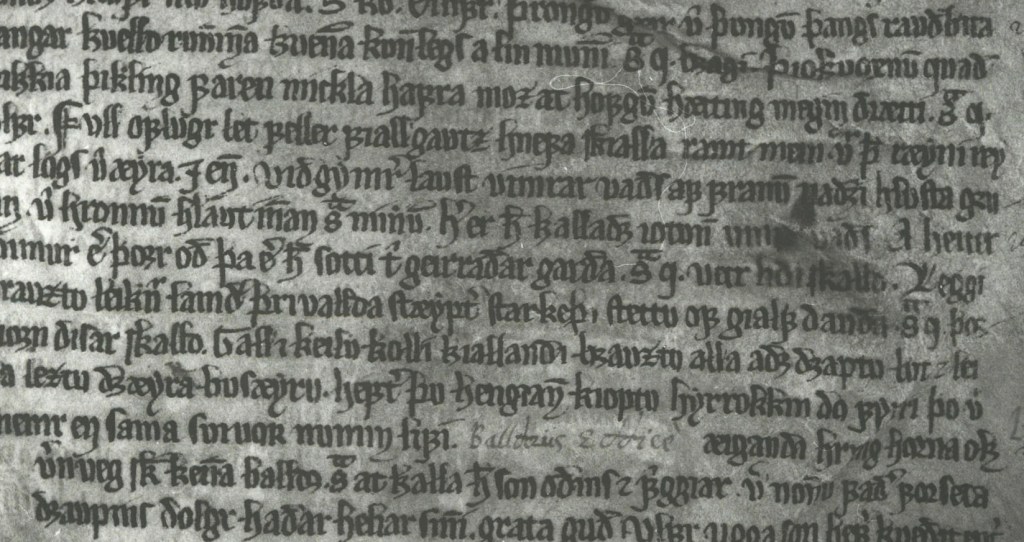
The skaldic poems about Thor are some of the most powerful and striking of all Old Norse poems. They detail his deeds, feats of strength and the enemies he has subdued. His opponents all giants and giantesses who have a negative and destructive nature attached to their being. The nature of these beings all have a theological element to play in conjunction to Thor, and his power as a deity.
One of my favorite Icelandic poets is Þorbjǫrn dísarskáld, who lived in the late 10th century. He wrote the following poem in celebration of Thor. It is addressed directly to Thor in an invocatory or liturgical fashion, which is a very distinct style of poetry we see associated with him. I’ll start with one of his longer poems.
The Old Norse version is as follows:
Ball í kolli Keilu, brauzt alla Kjallandi, áðr drapt Lút ok Leiða, lézt dreyra Búseyru, heptir Hengjankjǫptu, Hyrrokkin dó fyrri, þó vas snemr in sáma Svívǫr numin lífi.
The conventional translation is as follows:
“There was a clang on Keila’s crown, you broke all of Kjallandi, you had already killed Lútr and Leiði, you caused Búseyra to bleed, you bring Hengjankjǫpta to a halt, Hyrrokkin had died previously, yet the swarthy Svívǫr was even earlier deprived of life.”
Analyzing the names of these beings helps us understand the nature of these beings, and what they represent in relation to their killing by Thor. I’ll list this out line by line of this verse, so as to give a full exegesis on the beings.
Ball í kolli Keilu —
The scholastic consensus details the common use of keila as a name for a fish, namely cod or cusk. But looking further into the name, we see there is a similar word keilir, which denotes a wedge but also a mountain with a cone-like top. The term kolli, or kollr is the word used to denote the crown or the head, but additionally means the top or summit and denotes a rounded shape. The initial word ball is said to derive from bǫllr, which means a clanging or resounding, though the term ball is defined as to hit or hurt. We can assume as Thor hit the head of Keila, there was a clanging or resounding sound that resulted from it.
Thor is known for shaping of the landscape, as I mentioned in my previous essay. This is another instance of Thor using his hammer to smash an enemy and in the process shapes the landscape.
Brauzt alla Kjallandi —
Kjallandi is a name of a being listed in the tröllkvenna section of Skáldskaparmál, and her only other mention is here in this poem. The initial term kjall- derived from kjölr, meaning the keel or underside of a ship. The term is also used for a keel-shaped mountain ridge. But in the skaldic use, it refers back to the sea in terms like kjalarslóð, meaning keel-track, or kjalarstigr, meaning keel-path. Both terms are referencing the sea. A curiously similar word to Kjallandi is kjalarland, which relates to the sea as being the land of keels. This is a reference back to Thors influence upon the sea, being the creator of the tides as a result of his drinking trial at the hall of Útgarða-Loki.
As Thor breaks this being, he breaks and tames the sea and allows for better travel for sailors.
áðr drapt Lút ok Leiða —
The two beings here are the only males in this poem, which is not a coincidence by any means. The initial being Lútr derives his name from lúta, meaning to bow down, stoop or be bowed. The main use of the word is for bowing down as a sign of homage, or bowing in a reverential manner in both Heathen and Christian customs. The term denotes a yielding and giving way to a person in power or of higher authority. Though, it is also used in context of shame, as the term níðalútr shows. The shameful element is what the context here seems to denote, especially when we consider the second being Leiði, whose name derives from leiða or leiðr meaning loathed, or disliked.
There are multiple instances of Thors disdain for the shameful, loathed or lowly beings, such as in Þrymskviða 17, Lokasenna 57, 59, 61, and 63. In Eyrbyggja saga chapter 10, it is stated that there was a stone dedicated to Thor called Þórs steinn, which sat in the middle of a ring of stones called a dómhringr — a doom-ring. This is where judgements were held, and the backs of criminal men were broken on the stone.
Thor kills these beings because they are dishonorable and through their death restores proper rule of law.
Lézt dreyra Búseyru —
The name of this malignant being is Búseyra, which derives from the primary word bú, meaning a home, household, or generally any habitation that has a farm. The term also refers to stores and stock of a household. The secondary term seyra refers to famine, or starvation. The term is used in words like landseyra for famine of the land or a public famine. This being invokes Thors additional role as an agricultural deity. This is noted by Adam of Bremen in Gesta Hammaburgensis ecclesiae pontificum as he states that si pestis et famis imminet, Thorydolo lybatur — if there is famine, they libate, or drink to Thor. This being thus can be seen as one who attacks mankind and disrupts the abundance of a farm or household. It is the opposite of búsæld, or the abundance of a household.
With the killing of Búseyra, Thor returns abundance to the household.
heptir Hengjankjǫptu —
The primary word for this being is hengjan, hanging, which derives from hanga, to hang. The secondary word kjǫptu means jaw, and derives from kjaptr, meaning the same. The hanging nature of the jaw seems to connect back to the saying halda kjapti, which means to hold your jaw — to shut up. What we can ascertain from this, is that to have a hanging jaw is to tell lies, slander, and be given to verbal abuse, which is indicated by the terms kjaptæði and kjöptugr.
Thor is extremely adverse to lies and slander, given his reactions to the slander dealt out by Óðinn disguised as Hárbarðr in Hárbarðsljoð, and towards Loki in Lokasenna. This being can be seen as one who spreads lies and slander, and at one point was seized and restrained by Thor.
In doing so, Thor restores honesty between friends and family, and proper social cohesion.
Hyrrokkin dó fyrri —
Hyrrokkin is mentioned in Gylfaginning at the funeral of Baldr. Her name has been one of speculation throughout Eddic scholarship. Jan de Vries speculated that her name meant fire-wrinkled, denoting charred skin, and similarly, John Lindow has proposed fire-smoked denoting her skin. Analyzing her name further, the name seems to play into Thors influence on weather, as the Icelandic environment is prone to volcanic eruptions which cause the elements of her name, being of fiery elements.
Firstly, the term hyrr refers to embers and is used in poetry in kennings related to battle and gold. The second element of her name derives from rjúka, meaning smoke, steam and can be translated to reek in English. The term is also used in the nature of spraying, like water and moving suddenly or with violence. The nature of her being seems to be connected with the negative aspects of the volcanic environment of Iceland. Thor on the other hand, is said by Adam of Bremen to have control over serena et gubernat — clear skies, or fair weather and the growth of crops. Hyrrokkin should then be associated with bringing smoke and embers, obscuring the sky and rendering the land unable to grow crops.
By killing Hyrrokkin, Thor kills the fiery darkness caused by her — bringing clear skies and abundance back to the land.
þó vas snemr in sáma Svívǫr numin lífi —
This being is like Kjallandi, associated with the sea. The first word sví is an interjection of sorts, one of distaste, disgust or outrage. It is derives from sveia, which means to shout. The second word vǫr is related to vǫrr and ver, which means the sea or a fishing stead. Svívǫr is also called sáma which derives from sámr, meaning swarthy or dark. With all this in mind, we can understand this being as being associated with the dark and stormy seas, with the sound of the waves crashing so hard they were like shouting. This would have been detrimental to anyone fishing in the area, and is thus this being is malignant to the abundance of fishermen.
Thor governs fishing, and was seen as a great fisherman. In Hymiskviða, Thor catches the Miðgarðsormr on his line, and in Gylfaginning he caught Loki who was disguised as a salmon. When he caught him, he gripped his tail and caused all salmon from then on to change shape and be tapered toward the tail. In Bárðar saga snæfellsáss, a man named Ingjaldr was caught in a storm caused by a witch while fishing. He met a red-beared man named Grímr who disappeared when the storm became heavy. According to the saga, people said that it must have been Thor.
By killing Svívǫr, he calms the waters and brings abundance back to fishermen.
From this deep dive into the language, we are able to see the various theological elements surrounding Thor and how he puts down these harmful beings, in an effort to restore order to the world.
I plan on doing more commentaries in the future, so follow my site or my Instagram @clintonjmcmillan for more content and updates.
 Þórr siðr