Recently I have been going through and translating Wärend och Wirdarne by Gunnar Olof Hyltén-Cavallius. The book details many folk customs that derive from heathen practices and beliefs in Sweden.
A notable belief is the holding of thursday evening as holy, being called Thorshelg — meaning Thor’s holy day. There were many practices and taboos which persisted around the holy day. Many of these have sabbath-like customs of not working and prohibitions against certain actions.
Here are a few customs and beliefs that I found notable from this study:
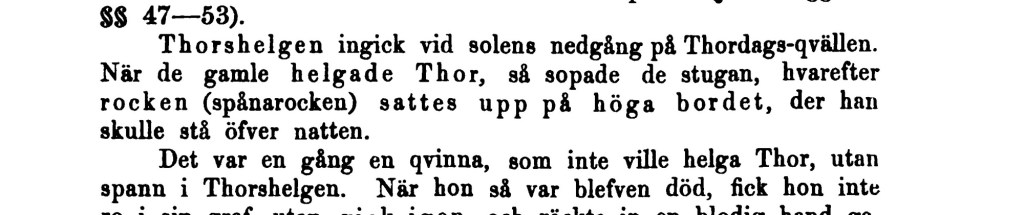
Thor’s holy day was followed on sunset on thursday evening. When the old people hallowed Thor, they swept the cabin, after which they spinning wheel was seated up on the high table, where it would stay overnight.
As soon as evening comes, the cabin must be kept well swept, scrubbed and clean, the table laid, candles lit with food and beer served. One must then keep absolutely quiet, with no one making loud noises, pounding, shouting, but must whisper what he wants to say. To do otherwise would bring calamity to the cattle. But above all, during Thor’s holy day, as well as during Yule and Passion week, no one must make circular motions.
To make circular motions on thursday evening is to go against the god Thor.
One must not drive a wagon on his own, nor lay twisted reins, not grind, either on the home quern or stone quern; not spin thread, not spin yarn, not even sweep hay for the cattle.
The reason that on Thor’s holy day that the spinning stick, or the spinning wheel must rest, is that on thursday night, Thor and Frigge spin, and so the wheel should be there for their behalf.
It is on thursday evening that Odin visits the rich farmers who served him; that same evening he should also be sought by those who wish to have company with him.
On the night of thursday, especially on the night of Holy Thursday, no one may travel outside, or he may then be hit by Odin’s arrows.
Another notable feature of this holy day, is that thunderstones were given offerings of beer and butter on thursday evening, being used to bring good luck in later years, as detailed by Christian Blinkenberg.
Such customs are holdovers from heathen ritual. The transference of ritual power to later domestic folk customs as times shows how belief and practices adapted over time and were sustained in action, even when times were not favorable to heathen gods.
The overwhelming amount of wealth in ethnological studies like this may warrant its own commentary at a later date.
 Þórr siðr