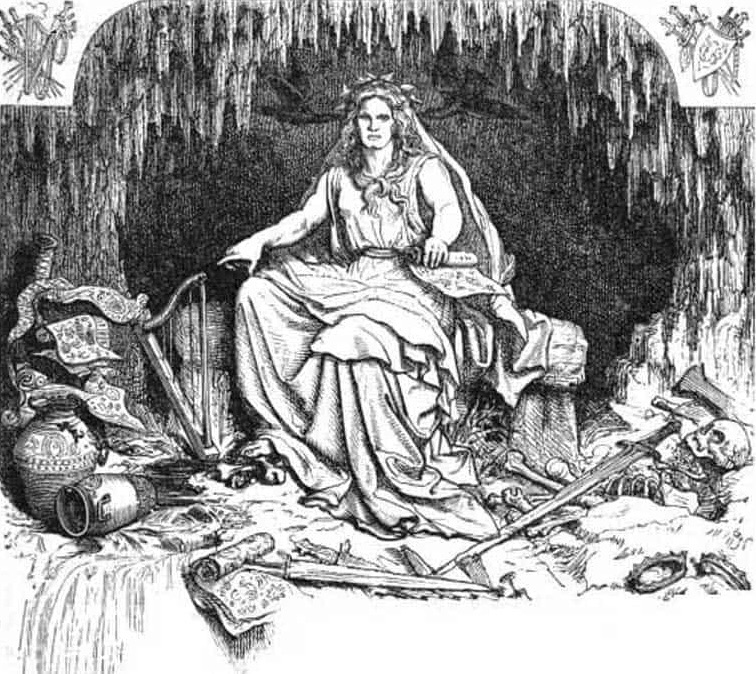
Thor in two particular instances is said to have struck Hel herself, and in one instance broke her legs. There seems to be a lost myth, or a variation of an existing myth where this event occurred within the cult of Thor.
In Þórsdrápa, he is called the blótinn Helhneitir, orthe worshipped Hel-striker.
In a skaldic poem by Vetrliði Sumarliðason retained in Skáldskaparmál, it is said that he leggi brauzt þú Leiknar —broke the legs of Leikn, Leikn being a byname for Hel as Viktor Rydberg has outlined in his Teutonic Mythology.
Thor also is said to have the ability to strike someone into Hel, that is into the underworld. This corresponds to the view in which Johannes Schefferus explains in Lapponia, which states that Thor governs valetudinem hominum, vitam, mortem, & id genus — the health of men, life, death and the like.
In Gylfaginning 26, he is said to have struck the jötun Smith into Niflhel, the deepest level of Hel:
“(…) ok nefndu Þór, ok þegar kom hann førði á lopt hamarinn ok guldu þá smíðarkaupit, ok laust hann í Hel ok sendu í Niflheim.”
“(…) they invoked the name of Thor, and immediately he came and raised his hammer aloft, and then they paid the builder’s wages and struck him into Hel, and sent him to Niflheim.”
In Lokasenna, he threatens to strike Loki into Hel for his slander:
“(…) þér skal minn þrúðhamar Mjölnir mál fyrnema; Hrungnis bani mun þér í Hel koma fyr nágrindur neðan.”
“(…) my mighty hammer Mjölnir shall silence you, Hrungnir’s slayer will send you to Hel, down below the corpse-gates.”
 Þórr siðr