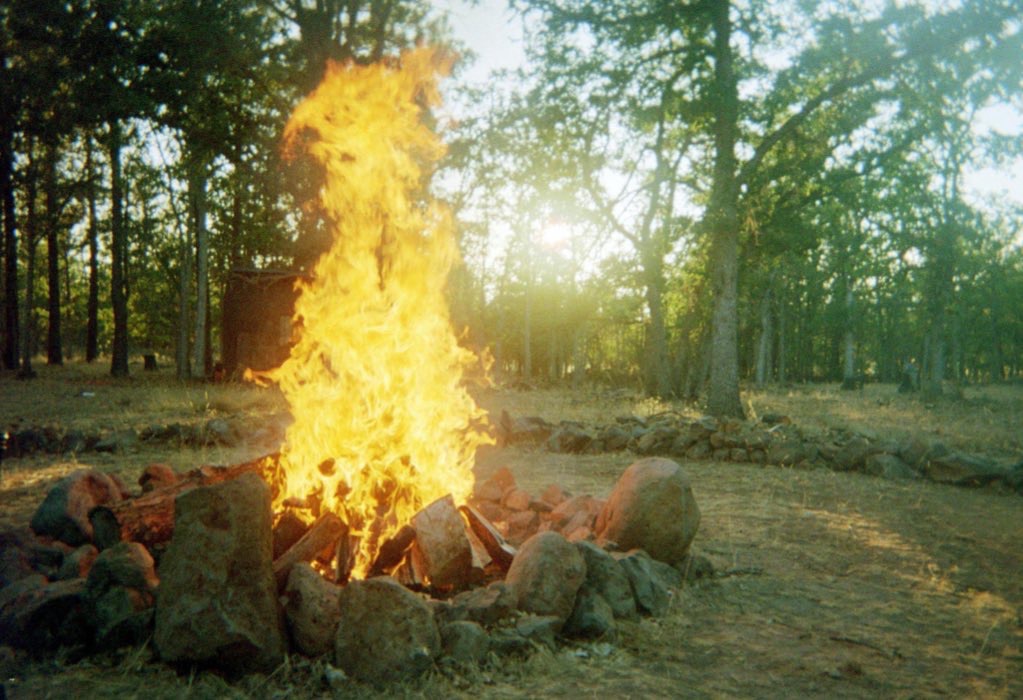
According to a more critical reading of the saga, the vígðan eld is not a perpetual fire.
In chapter 4 while Búi Andríðsson is in Brautarholt, he sees Þorsteinn Þorgrímsson entering the hof in the morning and sneaks into the hof. He kills Þorsteinn while he is lying prostrate before Þórr, and it is said that hann tók þá eldinn þann inn vígða ok tenraði — he then took the holy fire and lit it. The term tendraði, coming from tendra, meaning to make a fire or a light. He then sets the temple ablaze.
In chapter 2, it states that on the pedestal inlaid with iron in the hof, þar á skyldi vera eldr, sá er aldri skyldi slokkna. Þat kölluðu þeir vígðan eld — there should be a fire there that is never slaked. They called it a sacred fire. The term slokkna, from slökva, means to extinguish or to slake. Chapter 4 puts a new dimension on this ritual taboo, and that the fire is at certain times not active.
From the saga material, it seems that it was not lit at night and allowed to die out naturally and then relit in the morning. The prohibition against extinguishing the fire, means then that it is never intentionally extinguished.
Additional notes:
This procedure follows other eldsiðir such as the landnámeldr of the settlement age as found in Landnámabók. The fifth book outlines that it was decided that menn skyldu eld gera, þá sól væri í austri — men should make fire when the sun was in the east, or in the morning.
This process was said to hallow the land for the settler, or new owner of an already established property in the sagas. A good example of this is in Víga-Glúms saga, where Hallbera says to Víga-Glúmr:
“(…) komit hefi ek nú eldi á Þverárland ok geri ek þik, nú brott með allt þitt, ok er helgat landit Einari syni mínum.”
“(…) I have now brought fire to Þverárland and I will make you, now away with all yours, and the land is hallowed to my son Einar.”
This process was explicitly used for landownership and homeownership. Therefore it is wrong to use it on land that you do not formally own or seek to formally own.
 Þórr siðr