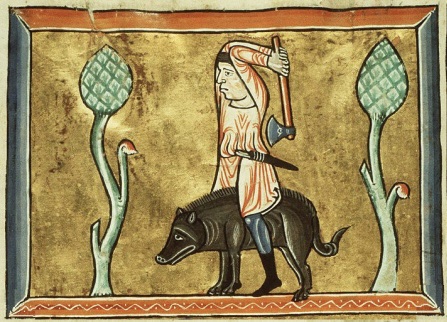
Nils Lid in Norske Slakteskikkar records historical folk customs of barring outsiders and strangers from the outside the family from witnessing the slaughter of animals. It is believed that some people bring with them the vonde augo — the evil eye, which is described as ovund, or envy. With it brings sorcery against the slaughterer and the farm and makes the animal difficult to kill and would spoil the meat, or not let the blood flow out properly.
This seems to be a reflex of older heathen customs such as in Austrfararvísur, wherein Sigvatr Þórðarson pokes his head into the farmhouse at a place called Hof, where an Álfablót was happening, and he was considered armr, or wretched in character — likely because he was of a foreign faith, being a Christian and brought ill with him.
Some attestations from Norske Slakteskikkar:
From Aurland show: “Do not let anyone stand and stare at it. Some folk can do something to the animal so that it becomes ‘siegliva’ (hard to kill).”
Others had it with them without meaning harm: “Some folk must not pass by” and “look in on the slaughter,” for then it might not be possible to get the life out of the animal. Old Aslak at Aurland parsonage was such a man.”
It is told from Sparbu that those who have “sjettaugna” (the sixth-eye) spoil the slaughter when they watch it.
From Telemark it is written: “In the byre one should preferably not let strangers enter; if they did not bring sorcery, it was the same as those who had envy or evil eyes, and it was nearly just as bad.”
Some additional attestations that are similar in context to Austrfararvísur:
From Eidfjord this information is given: “They were afraid of strangers at the slaughter-place.”
From Skafsa: “No stranger might enter while the animal was in the process of losing life, for then it would become “sieglivet” (hard to kill).”
Thus, it is recorded in Evanger: “They believed it was not good to let strangers see a creature that was about to be slaughtered. There are some who can cause harm merely by looking at the animal, so that it will not die.”
From Seljord: “No one other than those who helped with the slaughter was allowed to be present. If someone came sneaking and wanted to stand and watch while the animal was being killed, or if a passing stranger came by at that moment, then the animal would not die before that person interfered with it, they believed.”
From Tysvær: “Not many years ago, someone slaughtered a pig for his neighbor. Just then a vagrant came by. The slaughterer, who was out in the yard, did not want the vagrant there and chased him away. The man went up to the house and stood there and watched. When the slaughterer had stabbed the pig, no blood came out. This was of course the vagrant’s fault-and he got chased off the farm.”
And from Brekke: “If people stood in a hidden place, for example peeking through a peephole while someone slaughtered, it could easily happen that the animal would not fall down dead.”
Folk customs such as these are a way to bridge the gap between pre-Christian heathen religion and modern religion, as they retain echoes of older ritual rules and regulations. They are informative on the perspectives and beliefs of our ancestors, especially as it pertains to the reasoning for certain actions. When seeking an authentic expression of custom, we can and should learn from these attestations.
 Þórr siðr