Þórr and Þjálfi worshipped alongside Freyr in Piteå, northern Sweden in 1688 recounted by Uno Harva in Lappalaisten Uskonto:
“Että veralden olmai on todella ollut tunnettu Ruotsinkin Lapissa todistaa muun muassa erään lappalaisukon pappientarkastuksessa Pitimessä v. 1688 tekemä tunnustus, että hänellä oli ollut kolme puusta valmistettua jumalankuvaa, nim. ‘Thorin, Thorin palvelijan sekä maailman miehen eli jumalan’.”
That veralden olmai has indeed been known also in Swedish Lapland is shown, among other things, by the confession made by a Lapp man during a clerical inspection in Piteå in the year 1688, that he had had three wooden images of gods, namely: ‘Thor, Thor’s servant, and the man of the world, that is, the god.
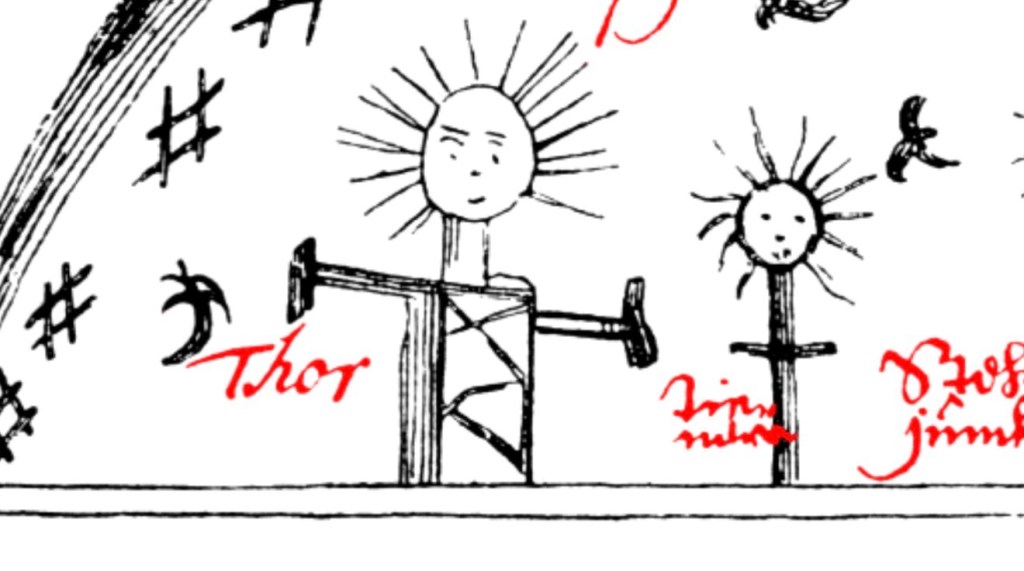
Þórr’s servant plays a pivotal role in the Sámi cult of Þórr, sometimes folklore refers to a singular servant or multiple, and other times they are called his sons. His servant/son is often depicted on rune-drums in anthropomorphic form, or in a similar cross-form depiction as him.
Sometimes they are known in Swedish as Thorens söner (Thor’s sons), Thorens drängar (Thor’s farmhands), Tordengudens dreng (Thunder-god’s farmhand), or Thordens striidsman (Thunder’s warrior). In Sámi he is called Thoor-olmai, literally Thunder-man. Similar motifs are present in Finnish folklore, being called Ukon Poika, (Ukko’s son). In the 10th century poem Þórsdrápa, Þjálfi is called sifuni implying a blood-relation or marriage-relation.
These attestations show an important ritual agency of Þórr’s servants and his sons in the cult, and direct interaction with human ritual agents, who are able to release the god and send him against their enemies.
 Þórr siðr